
Photo by Team TGM
Running A/B tests while staying privacy-compliant feels like a trade-off most marketers don’t know how to make. This guide breaks down exactly how privacy-first A/B testing works, why cookie-based experiments are putting your business at legal risk, and how to run smarter, consent-based experimentation without losing test quality. No legal jargon. No guesswork. A clear, practical path to ethical CRO that builds trust and still moves your conversion numbers.
Table of Content:
What Is Privacy-First A/B Testing, and Why Does It Matter Right Now?
Privacy-first A/B testing is the practice of running controlled experiments on your website or app using methods that do not rely on third-party cookies, invasive tracking, or data collected without user knowledge. Instead, it uses first-party data testing, anonymous session identifiers, and consent-based experimentation frameworks to generate statistically valid results, without crossing legal or ethical lines.
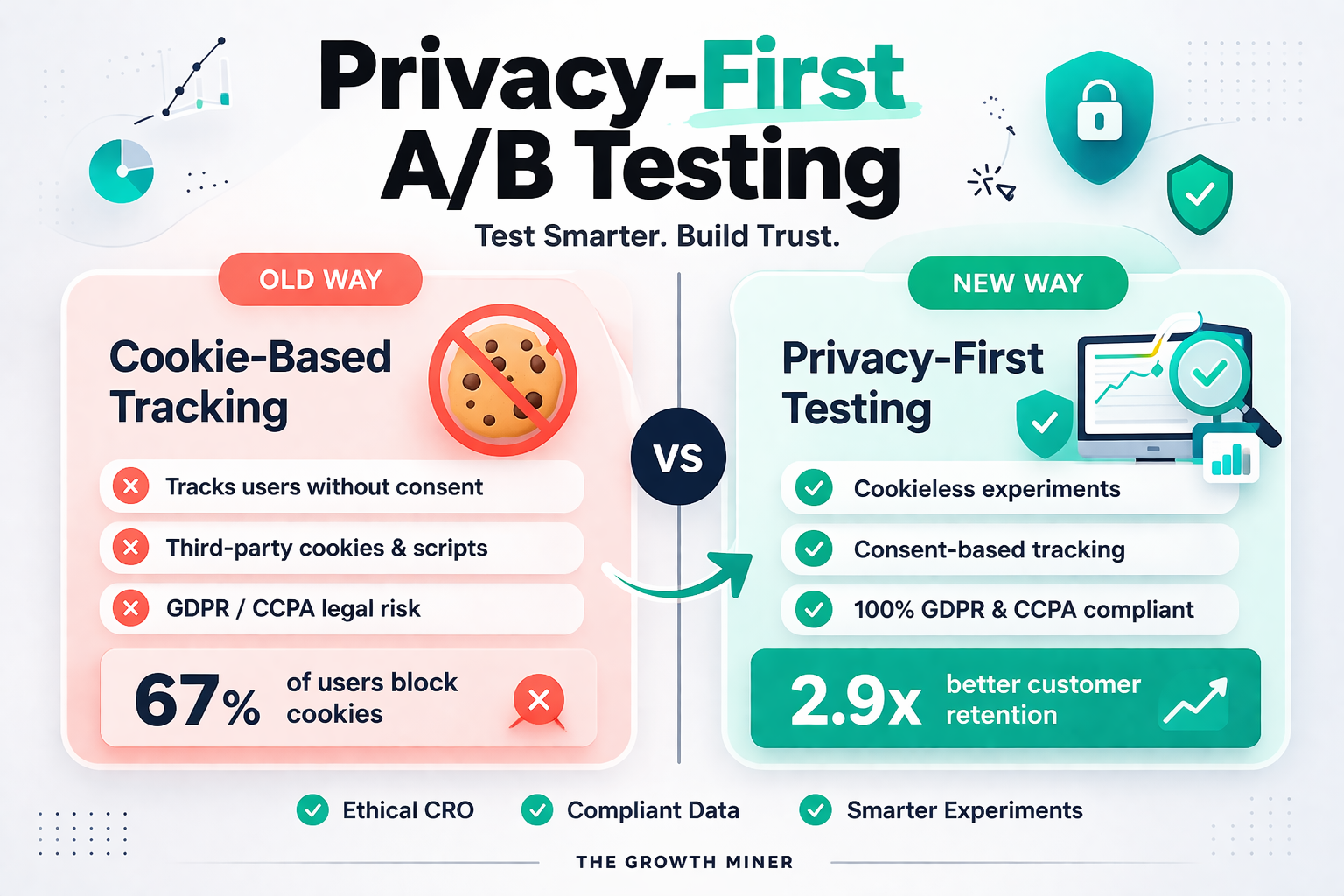
This matters right now because the environment your tests run in has fundamentally changed. Nine out of ten Americans say online privacy is important to them. At the same time, 67% of U.S. adults have turned off cookies or website tracking to protect their privacy, and that number continues to grow each year. If your A/B testing setup still depends on third-party cookies or unconsented tracking, a significant portion of your test audience is already invisible to you, and your results are skewed before you even start.
The shift is not theoretical. It is already affecting how experiments run, how data gets collected, and whether your business stays on the right side of privacy law.
Is Your Current A/B Testing Setup Putting You at Legal Risk?
Yes, it likely is, if you are still running traditional cookie-based experiments without a proper consent layer.
GDPR A/B testing compliance requires that any data processing tied to non-essential tracking, including the kind used in most A/B testing tools, must have a valid legal basis. For marketing experiments, that almost always means explicit user consent. The same applies under the California Consumer Privacy Act (CCPA), which gives users the right to opt out of data collection used for targeting and personalization.
The consequences of getting this wrong are no longer hypothetical. Cumulative GDPR fines have now passed €7.1 billion. TikTok alone was fined €530 million in 2025 for data handling failures. And 67% of cookie consent implementations currently have technical errors, most of which default to “granted” before users actually make a choice.
For small business owners and WordPress freelancers, this is not just a big-brand problem. Regulators are actively expanding enforcement. The Dutch Data Protection Authority now monitors approximately 10,000 websites annually and plans to warn 500 organizations per year.
What non-compliance actually looks like in practice:
- Your A/B testing script fires before a user accepts or rejects your cookie banner
- You are collecting behavioral data on EU or California visitors without a documented legal basis
- Your consent banner has no real “reject” option, or uses dark patterns to push acceptance
- Your testing platform stores persistent identifiers without user knowledge
AI A/B testing compliance adds another layer. If you are using AI-powered experimentation tools that build user profiles or automate personalization decisions, those systems are subject to additional scrutiny under both GDPR and the EU AI Act. 40% of organizations now report AI-related privacy breaches. Running AI-driven tests on unconsented data is one of the fastest ways to end up in that statistic.
Are Your Visitors Actually Converting, or Just Clicking?If your CRO strategy isn’t built around how today’s informed visitors behave, your A/B tests are optimizing for the wrong thing. Before you fix your testing setup, understand who you’re actually testing on. Read: CRO for AI-Educated Visitors → |
What Is Cookieless A/B Testing and How Does It Work?
Cookieless A/B testing means running experiments without relying on third-party cookies or persistent cross-site identifiers to assign users to test variants. It works by replacing those tracking mechanisms with privacy-safe alternatives that still produce statistically reliable results.
Here is how the core methods work:
Server-side testing: Instead of firing a JavaScript snippet in the user’s browser, the experiment logic runs on your server. The variant is delivered before the page reaches the user, meaning no tracking script touches the browser at all. This is the most privacy-compliant approach, and it is also more accurate because it is not affected by ad blockers or browser privacy settings.
Anonymous session identifiers: Rather than storing a persistent user ID tied to a profile, a temporary session ID is generated for each visit. It expires when the session ends, tracks nothing across visits, and collects no personal data. The test can still register which variant a user saw and whether a conversion happened, without knowing anything about who the user is.
First-party data testing: You run experiments using data collected directly from users on your own properties, with their knowledge and consent. Purchase history, on-site behavior, declared preferences — all collected through a direct relationship. Companies leveraging first-party data strategies achieve 2.9x better customer retention and 1.5x higher marketing ROI compared to cookie-dependent approaches.
Aggregate and modeled data: For situations where even session-level data feels too granular, some platforms use statistical modeling to infer test outcomes from aggregate behavior patterns, rather than individual-level tracking.
A/B testing without cookies does not mean less insight. It means cleaner, more defensible insight, built on data you actually have the right to use.
How Do You Run Consent-Based A/B Experiments the Right Way?
Consent-based experimentation means building the user’s permission into your testing workflow from the very start, not as an afterthought or a legal checkbox. Here is how to do it correctly.
Step 1: Deploy a proper Consent Management Platform (CMP)
A CMP is the system that collects, records, and enforces user consent choices across your site. It is not just a cookie banner. It must block all non-essential tracking scripts, including your A/B testing tool, until the user has made an active choice. Pre-ticked boxes, cookie walls, and banners with no visible “reject” option all violate GDPR requirements and signal bad faith to regulators.
Step 2: Apply data minimization from the experiment design stage
Before you run any test, ask: what is the minimum data needed to answer this question? Under GDPR Article 5(1)(c), you can only collect data that is strictly necessary for your stated purpose. If you are testing a headline, you do not need to know the user’s location, device history, or browsing behavior. Design your experiment to collect only what it needs.
Step 3: Use pseudonymization for any stored test data
If your testing platform logs which variant a user saw, replace any identifiable fields with a pseudonym or anonymous token. This means that even if the data were accessed without authorization, it could not be traced back to a specific individual. Most modern experimentation platforms handle this automatically, but always verify your platform’s data handling settings.
Step 4: Document everything
GDPR requires that you can demonstrate how consent was obtained, what information was shown to the user, and when permission was granted. Without immutable consent logs retained for at least five years, regulatory investigations become indefensible. Your CMP should be storing this automatically. If it is not, that is a gap worth fixing before your next campaign goes live.
Step 5: Honor opt-outs in real time
If a user withdraws consent mid-session, your test must stop collecting data from that user immediately. This is not optional under GDPR or CCPA. Global Privacy Control (GPC) signals must be honored automatically when users enable privacy-preserving browser settings. Build that into your experimentation workflow.
User consent experimentation is not a limitation on what you can test. It is a more accurate foundation for testing, because every data point in your results comes from a user who knowingly engaged with your site.
Can AI Make Privacy-First A/B Testing Smarter?
Yes, but only when it is set up correctly. AI is becoming one of the most useful tools in ethical AI marketing experimentation, but it also introduces new risks if the underlying data practices are not sound.
Federated learning is one of the most promising applications. Instead of sending user data to a central server for analysis, federated learning trains models locally on the user’s device. The insights, not the raw data, are shared. This means you can improve personalization and test targeting without ever moving personal data off the user’s device. It is particularly relevant for federated learning marketing use cases like optimizing email send times or ad creative without building individual profiles.
Differential privacy is another approach gaining traction in experimentation. It works by adding calibrated statistical noise to datasets, so that the results of an analysis cannot be traced back to any individual user. For CRO teams, differential privacy CRO means you can analyze test results across large user groups without exposing individual-level behavior. Google and Apple both use versions of this in their own data systems.
AI-powered variant generation can suggest which elements to test, based on patterns in your consented first-party data, saving time without requiring any expansion of your data collection.
The important guardrail: 1 in 6 data breaches now involve AI-driven attacks. If your AI experimentation tools are pulling from unconsented or poorly governed data sources, the efficiency gains are not worth the exposure. AI A/B testing compliance requires the same consent and minimization standards as any other form of testing. The technology does not create an exemption.
Running Tests on Shopify? Here’s What Actually Works.Privacy-first testing is especially important for e-commerce, where trust directly affects purchase decisions. These apps make it easier to run compliant, effective experiments on your Shopify store. See the Best Shopify A/B Testing Apps → |
What Tools Support Privacy-First A/B Testing in 2025-2026?
Choosing the right platform matters because not all A/B testing tools are built with privacy compliance as a default. Here are the categories and examples worth knowing:
Server-side experimentation platforms Tools like GrowthBook (open-source, warehouse-native) and Statsig support server-side testing with built-in anonymization. GrowthBook in particular is designed around transparent SQL-based analysis, which makes it easier to audit exactly what data is being used.
Privacy-focused analytics with built-in testing Convert has published its own 2025-2026 experimentation data and is built with GDPR compliance as a core feature, including automatic data minimization and granular consent management.
Cookieless and first-party platforms Plausible and Fathom are analytics-first tools that do not use cookies or store IP addresses, and are used by over 500,000 and 200,000 sites respectively. While not dedicated A/B testing tools, they integrate cleanly with consent-based experimentation setups.
Consent Management Platforms (CMPs) Any testing stack needs a CMP underneath it. OneTrust and Secure Privacy both support GDPR, CCPA, and over 55 global privacy laws, with automatic script blocking before consent is captured.
When evaluating any tool, ask three questions: Does it support server-side deployment? Does it block tracking before consent is given? Does it give you audit-ready consent logs?
What Are the Key Principles of Ethical CRO Practices?
Ethical CRO practices are not just about legal compliance. They are about building a testing program that your users would not object to if they could see exactly how it works. These principles keep you on the right side of both regulation and user trust.
Data minimization: Only collect what you need for the specific test you are running. Every additional data point is an additional liability, legal and ethical.
Purpose limitation: Do not use data collected for one experiment to inform a different targeting decision downstream. Under GDPR, data must only be used for the purpose it was collected for.
Transparency: Be clear with users that your site runs optimization tests. Most privacy policies do not mention experimentation at all, which is a gap worth closing.
No dark patterns in consent flows: Manipulating users into accepting tracking through confusing design, buried reject buttons, or pre-ticked boxes is not just bad ethics, it is illegal under GDPR and increasingly enforced. Well-optimized cookie consent designs can achieve 200% higher acceptance rates versus defaults through ethical A/B testing and consent analytics. You do not need manipulation to get consent. You need a clear design.
CCPA compliant personalization requires that any personalization driven by user data must have a clear opt-out mechanism. If your test variants involve personalized content, that process needs to be disclosed and reversible.
The payoff for getting this right is real. 81% of consumers now factor in trust before making a purchase. A testing program built on ethical principles is not a slower testing program. It is a more trusted one, and trust converts.
Is SEO Still Worth Your Time in the AI Era?Privacy-first testing and SEO are both shifting because of AI. If you’re wondering whether the fundamentals still hold, this guide breaks it down clearly. Read: Is SEO Still Worth It in the AI Era? → |
Key Takeaways: What This Article Tells You About Privacy-First A/B Testing
Privacy-first A/B testing is not a workaround or a downgrade. It is the standard that experimentation is moving toward, and the businesses that build it into their CRO workflows now will be better positioned as enforcement tightens and user expectations rise.
Here is what this article covered:
The problem is real and already here. GDPR fines have crossed €7.1 billion. 67% of U.S. adults are blocking cookies. 67% of consent implementations have technical errors. If your testing stack has not adapted, it is running on a foundation that is both legally exposed and data-incomplete.
Cookieless and consent-based methods work. Server-side testing, anonymous session IDs, and first-party data are not compromises. Companies using first-party data strategies see 2.9x better customer retention. The quality of your data improves when it comes from consented, direct relationships.
Consent is a workflow, not a banner. A proper CMP, data minimization at the design stage, pseudonymization, real-time opt-out enforcement, and five-year consent logs are all part of a compliant experimentation setup. None of them happen by default.
AI tools can help, but they need guardrails. Federated learning and differential privacy are making privacy-safe personalization more accessible, but AI does not create an exemption from consent requirements.
Ethical CRO builds trust, and trust converts. 81% of consumers factor in trust before buying. A testing program users would feel comfortable knowing about is also one that delivers better, more reliable results.
For more practical guides on CRO, A/B testing, and navigating the AI era of digital marketing, The Growth Miner is the resource built specifically for this. Whether you are a beginner blogger, a small business owner, or a WordPress freelancer, the frameworks here are designed to help you grow without the guesswork.
-
Regular A/B testing often relies on third-party cookies and persistent user tracking to assign visitors to test variants. GDPR A/B testing requires that any data processing tied to non-essential tracking has explicit user consent before it begins. This means your testing tool must not fire until the user has actively accepted cookies, and you must have a documented legal basis for every data point collected in your experiment.