Photo by Team TGM
A few years ago, building a professional website meant choosing between WordPress, custom development, or no-code tools like Webflow.
Today, the situation looks very different.
AI can now:
- Build website layouts in minutes
- Write landing page copy instantly
- Generate images, videos, and even animations
- Optimize SEO automatically
So a very fair question arises:
If AI can build websites so fast, is Webflow still worth using?
This article answers that question honestly, without hype — so that by the end, you clearly know whether Webflow still makes sense for you in the AI era.
Table of Content:
Why This Question Even Exists Today
AI website builders promise something very attractive:
“Tell us what you want, and we’ll build your website instantly.”
For beginners, small businesses, and non-technical users, this sounds perfect. Tools like Wix AI, Framer AI, Shopify Magic, and other AI builders focus heavily on speed and automation.
Webflow, on the other hand, does not promise instant results. It promises control, structure, and quality.
That difference is exactly why people are confused today.
What Webflow Actually Is (And What It Is Not)
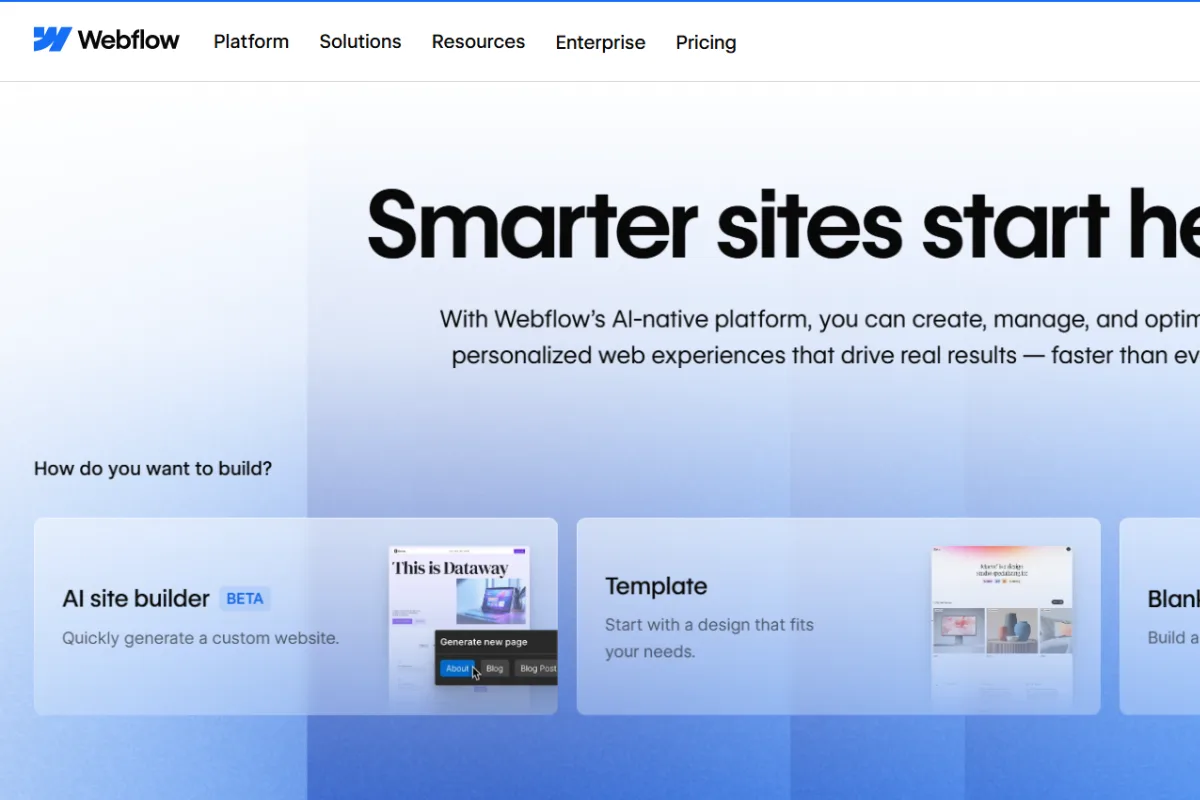
Webflow is not an AI website builder.
Webflow is a visual web development platform that lets you design websites visually while generating clean HTML, CSS, and JavaScript in the background.
Think of Webflow as:
- More powerful than drag-and-drop builders
- Easier than manual coding
- Designed for long-term, professional websites
This is why Webflow is widely used by:
- Designers and agencies
- SaaS startups
- Marketing teams
- Content-driven businesses
(Read for more detail: What Is Webflow?A Beginner-Friendly Guide)
How AI Is Actually Changing Website Building (Reality Check)
AI is amazing — but it’s important to understand what AI is good at and what it is not.
AI is excellent at:
- Generating ideas and drafts
- Speeding up repetitive work
- Creating starting points
AI struggles with:
- Brand identity
- Unique layouts
- Complex site structure
- Long-term scalability
This is where the real difference between AI builders vs Webflow appears.
AI builders are great at starting fast.
Webflow is great at building something that lasts.
Does Webflow Use AI Today? Yes — Just Differently
Webflow does not force AI into your workflow. Instead, it allows you to use AI where it makes sense.
In real-world usage, Webflow users commonly:
- Write content using AI tools and refine it inside Webflow
- Create visuals using Canva AI and upload them
- Use AI SEO tools to optimize Webflow CMS pages
- Automate tasks using Zapier + AI tools
(Read for more detail: Best Third-Party Integrations for Webflow)
Pro tip:
Webflow works best when AI is used as an assistant, not as the decision-maker.
Webflow vs AI Website Builders: The Real Difference
Let’s remove marketing language and talk practically.
AI website builders focus on:
- Speed
- Templates
- Automation
Webflow focuses on:
- Design precision
- Performance
- SEO control
- Scalability
If you just want a quick site that “looks okay,” AI builders win.
If you want:
- A strong brand
- SEO-friendly structure
- Full control over layout and behavior
Webflow still clearly wins.
Why Webflow Still Makes Sense in the AI Era
1. Design Freedom AI Can’t Match
AI builders generate layouts based on patterns.
Webflow allows intentional design.
Every spacing decision, animation, interaction, and layout choice is under your control — something AI cannot truly replicate yet.
2. Clean Code = Better Performance
Webflow generates cleaner code than most AI builders.
This directly impacts:
- Page speed
- Core Web Vitals
- SEO rankings
( Read More: How to Do SEO on Webflow)
3. SEO Control That AI Builders Hide
Most AI builders simplify SEO to a few toggles.
Webflow gives you:
- Full meta control
- Clean URLs
- Proper heading hierarchy
- CMS-level SEO customization
For content-driven websites, this matters a lot.
4. Scalability Without Rebuilding Everything
Many AI websites look great on day one — and become limiting later.
Webflow is built for:
- Adding new pages
- Expanding CMS
- Scaling traffic
- Supporting marketing growth
Pro tip:
If you plan to grow your website over time, Webflow saves you from painful migrations later.
Where Webflow Honestly Struggles
Let’s be real — Webflow is not perfect.
- Learning curve is higher than AI builders
- Pricing is not beginner-cheap
- No instant “generate my whole site” feature
This is why Webflow is not for everyone, and that’s okay.
Who Should Choose Webflow in 2025
Webflow is a strong choice if you are:
- A designer or marketer
- A startup building a serious brand
- Running a content-heavy website
- Focused on SEO and performance
Webflow may not be ideal if you:
- Want a one-day hobby site
- Have zero interest in learning
- Only need a temporary website
Webflow + AI: The Smartest Setup Going Forward
The future is not Webflow vs AI.
The future is Webflow + AI.
AI handles:
- Speed
- Drafts
- Inspiration
Webflow handles:
- Structure
- Quality
- Control
- Growth
This combination is what professionals are already using.
Final Conclusion: Is Webflow Worth It in the Age of AI?
Yes — Webflow is absolutely worth it, but for the right reasons.
Webflow is not trying to compete with AI on speed.
It competes on quality, control, and long-term value.
If you want a website that:
- Looks professional
- Ranks well on Google
- Scales with your business
- Stays relevant even as AI evolves
Webflow remains one of the strongest platforms available.
-
No. Webflow focuses on professional websites, while AI builders focus on quick automation.